
In the emerging nature economy, a single question looms large: How do we measure the condition of nature in a way that is scientifically robust, globally scalable, and locally actionable?
For financial institutions, corporations, and land stewards, the lack of a unified language for ecosystem health has been a barrier. We have good data on pressures like land conversion and growing data on ecological responses like species abundance, but we have lacked a consistent “vital sign” for the ecosystem itself.
Today, The Landbanking Group is open-sourcing the Ecosystem Integrity Index (EII) code and global dataset to bridge this gap.
The Proxy Problem: Why Perfect Measurement Isn’t the Goal
Nature is inherently complex. No single index will ever capture the “true” state of an ecosystem in all its biological, chemical, and physical dimensions. Many ecologically-driven measurement approaches recognize this and respond by demanding ever more data: species inventories, water sampling, soil analysis, genetic surveys—each adding fidelity but also friction.
The result is often rigorous science that cannot scale. An approach requiring local species monitoring or bespoke field protocols may work beautifully for a research site, but it cannot be deployed across a global investment portfolio or applied consistently from the Amazon to the Scottish Highlands.
We take a different view: the goal is not to measure everything, but to establish a trustworthy proxy that is good enough to be actionable. The EII is designed to get “close enough” to ecological reality that it can reliably inform decisions: screening assets, setting targets, and tracking progress, without requiring prohibitive local adaptation or data collection for every site on Earth.
This approach maintains scientific integrity while recognizing that for nature to participate in markets, we need metrics that can operate at market scale.
Beyond Static Maps: A Dynamic, Global Standard
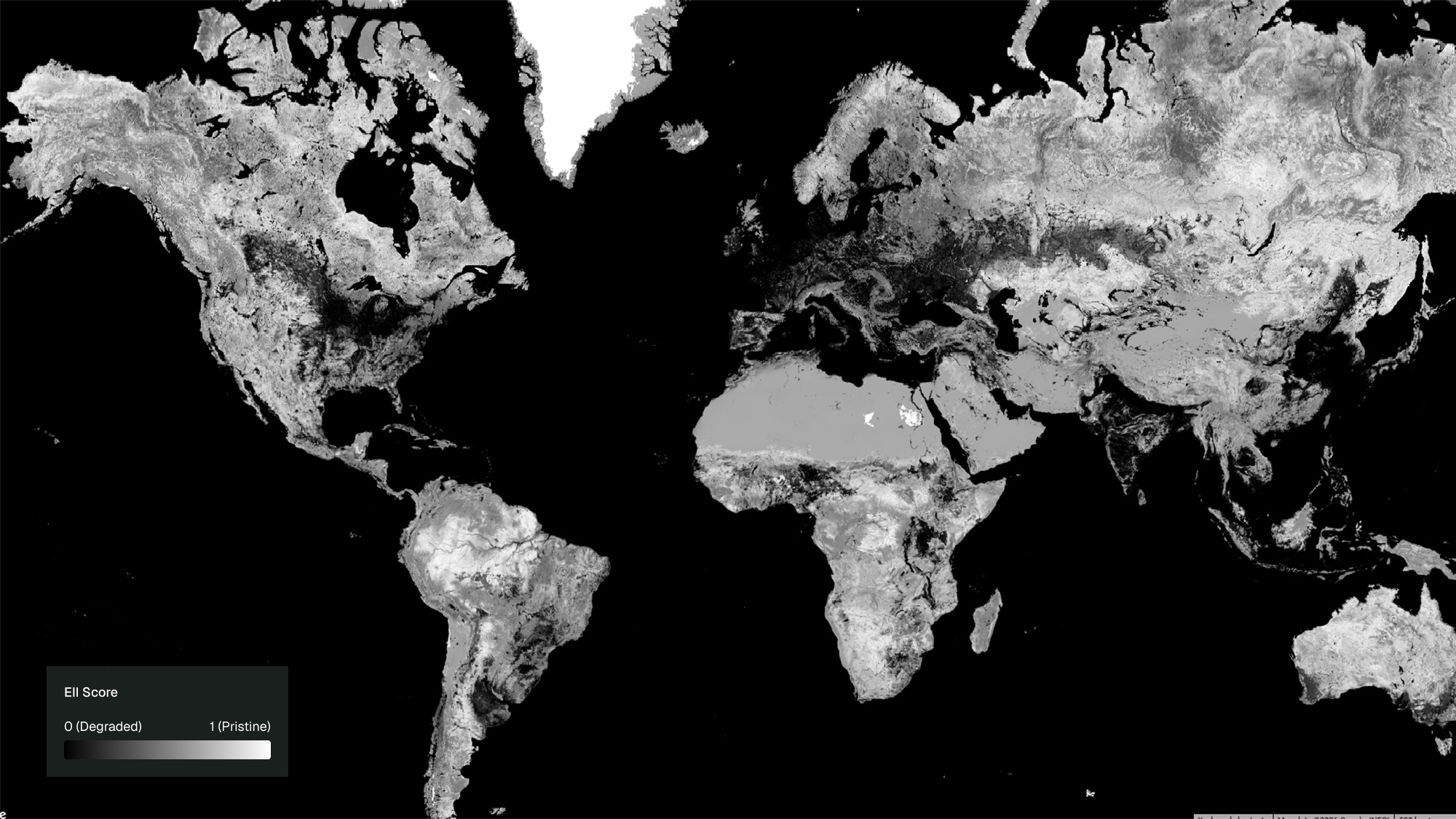
The EII is a dynamic, computational framework designed to assess the “integrity” or health of ecosystems anywhere on Earth at 300-meter resolution.
Our implementation builds on the pioneering conceptual framework originated by UNEP-WCMC and featured in major disclosure frameworks like the Taskforce on Nature-related Financial Disclosures (TNFD) and the Nature Positive Initiative (NPI). It provides a standardized way to score nature’s condition from 0 (degraded) to 1 (intact).
To be truly useful for the transition to a nature-positive economy, an index must meet three critical criteria:
- Global Scalability: It must be computable everywhere, for any location, without requiring bespoke local data collection. This enables rapid portfolio scanning and global benchmarking.
- Ecological Credibility: It must be grounded in established science and capture enough of nature’s complexity to serve as a trustworthy proxy for ecosystem health.
- Local Actionability: It must respond to actual improvements on the ground to reward genuine restoration efforts.
The Three Pillars of Integrity
The EII achieves ecological credibility by synthesizing three fundamental dimensions of ecosystem health, which together provide a robust signal without requiring exhaustive local measurement:
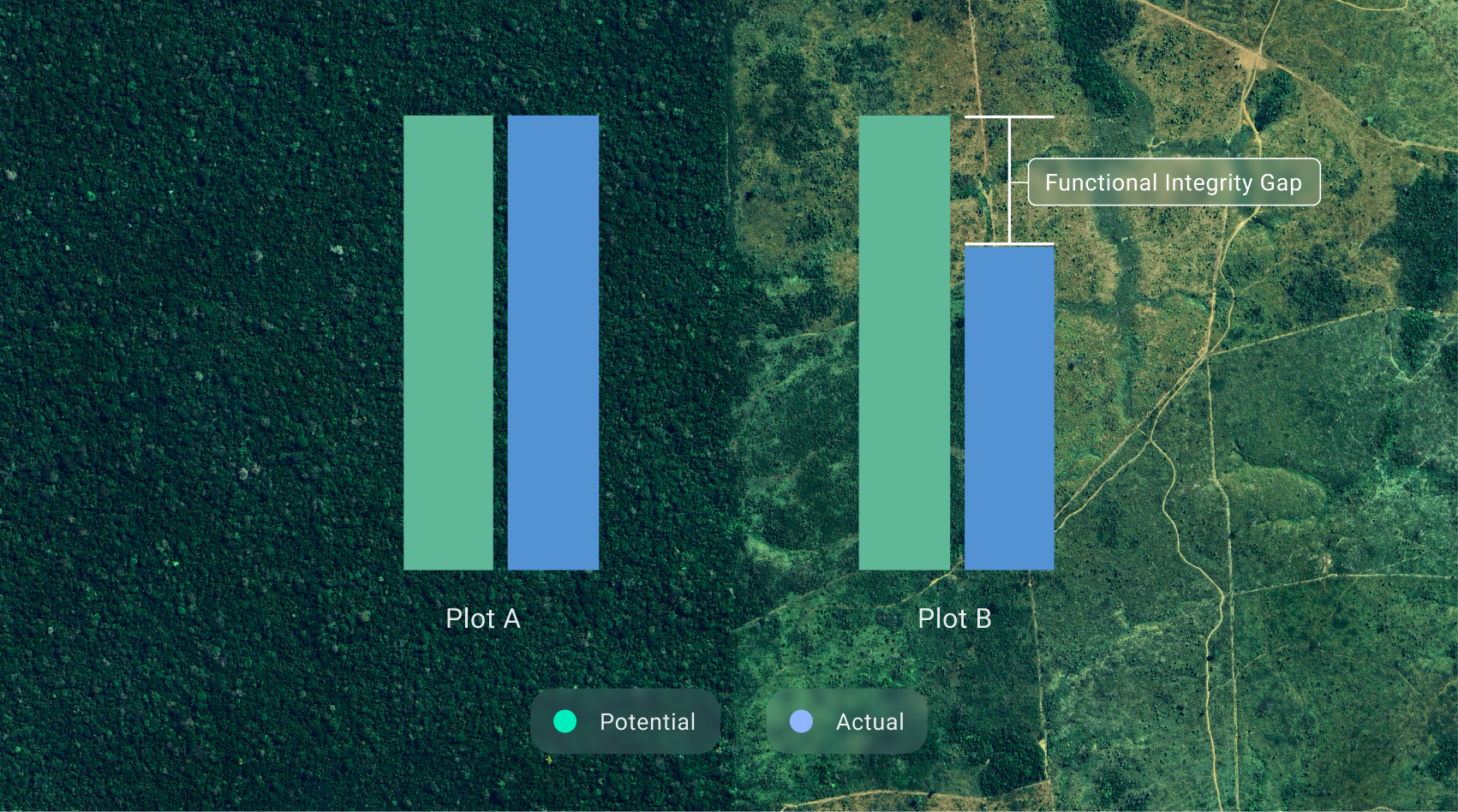
- Functional Integrity: This is the “engine” of the ecosystem. We measure this by comparing actual Net Primary Productivity (NPP) derived from satellite observation against a predicted potential natural productivity. This comparison tells us if the system is capturing energy and cycling nutrients as it would if unmodified.
- Structural Integrity: This represents the “architecture” of the landscape. We quantify habitat fragmentation and landscape configuration to ensure habitats are large and intact enough to support viable populations.
- Compositional Integrity: This reflects the “community” of life. We integrate the Biodiversity Intactness Index (BII) to estimate the abundance of native species relative to a pristine baseline.
Each pillar draws on globally available data—satellite observations, land cover maps, biodiversity models—that can be applied consistently anywhere without requiring site visits or local calibration.
The Limiting Factor Principle: Why All Three Pillars Matter
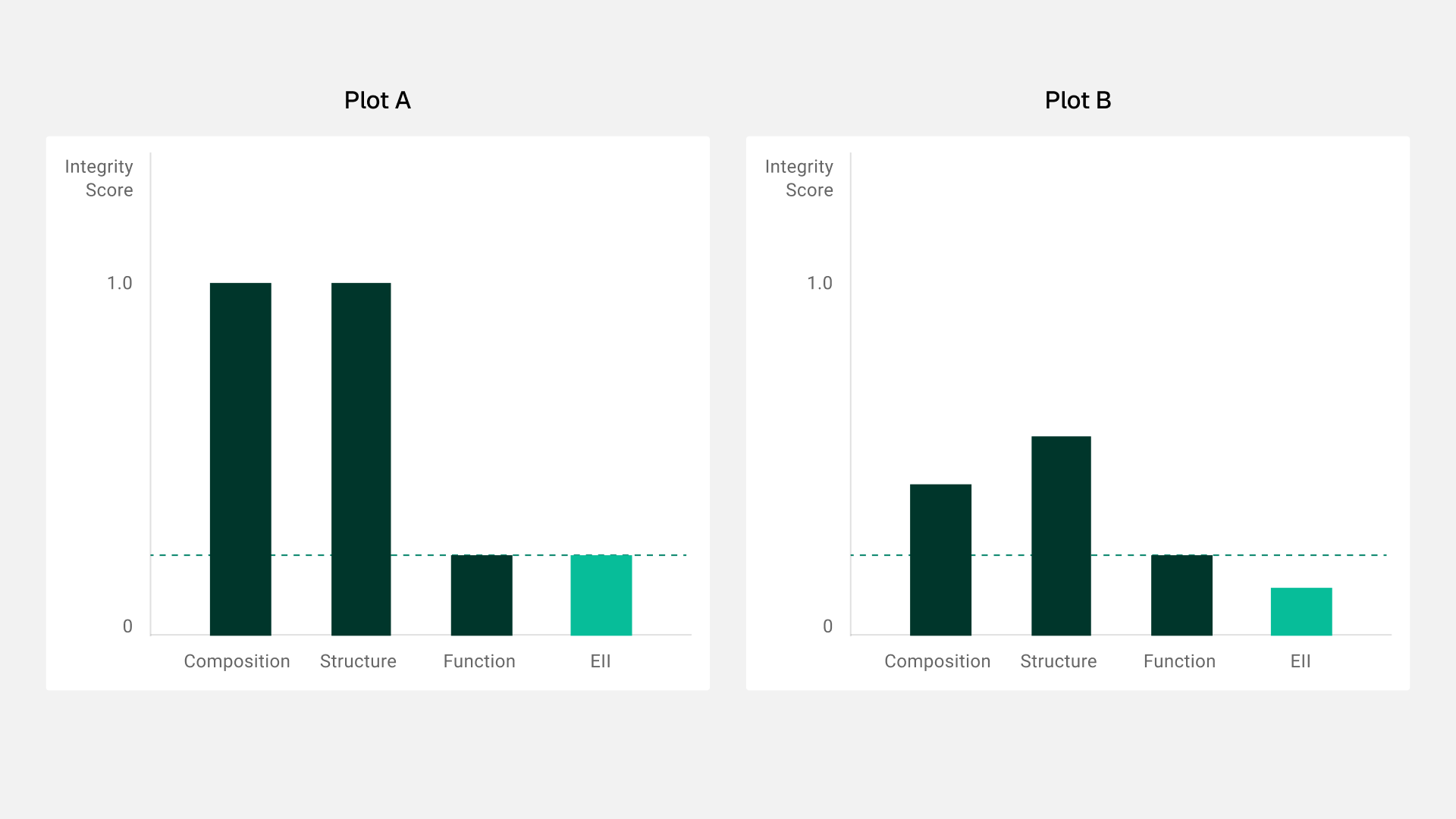
A critical design choice in the EII is how we combine these three scores into a single index. A simple average would be misleading: it could mask severe degradation in one dimension if the others perform well.
Consider a eucalyptus monoculture plantation. It might score high on Functional Integrity: the trees are photosynthesizing vigorously, capturing carbon, and showing strong productivity. It might even score reasonably on Structural Integrity if it forms a large, contiguous block. But its Compositional Integrity would be near zero: monocultures support only a fraction of the native species that a natural forest would host.
If we averaged these scores, the plantation might appear moderately healthy. But ecologically, it is impoverished.
The EII solves this by applying the Limiting Factor principle, inspired by Liebig’s Law of the Minimum in ecology: just as a plant’s growth is constrained by the scarcest nutrient, an ecosystem’s integrity is constrained by its weakest dimension. The final EII score is anchored to the lowest-performing pillar. If multiple pillars are degraded, the score is further reduced through a fuzzy logic adjustment.
This approach ensures that no amount of productivity can compensate for biodiversity collapse, and no amount of species richness can mask a fragmented, degraded landscape.
Bridging the Gap: The “Local Modulation” Innovation
Perhaps the most significant challenge in nature metrics is the “actionability gap.” Global models are driven largely by landscape-scale data, so they often fail to register the subtle but critical improvements made by a local land steward. Improvements such as soil health or hedgerow planting may not yet alter the satellite signal.
Our implementation of EII introduces a novel solution called Local Modulation.
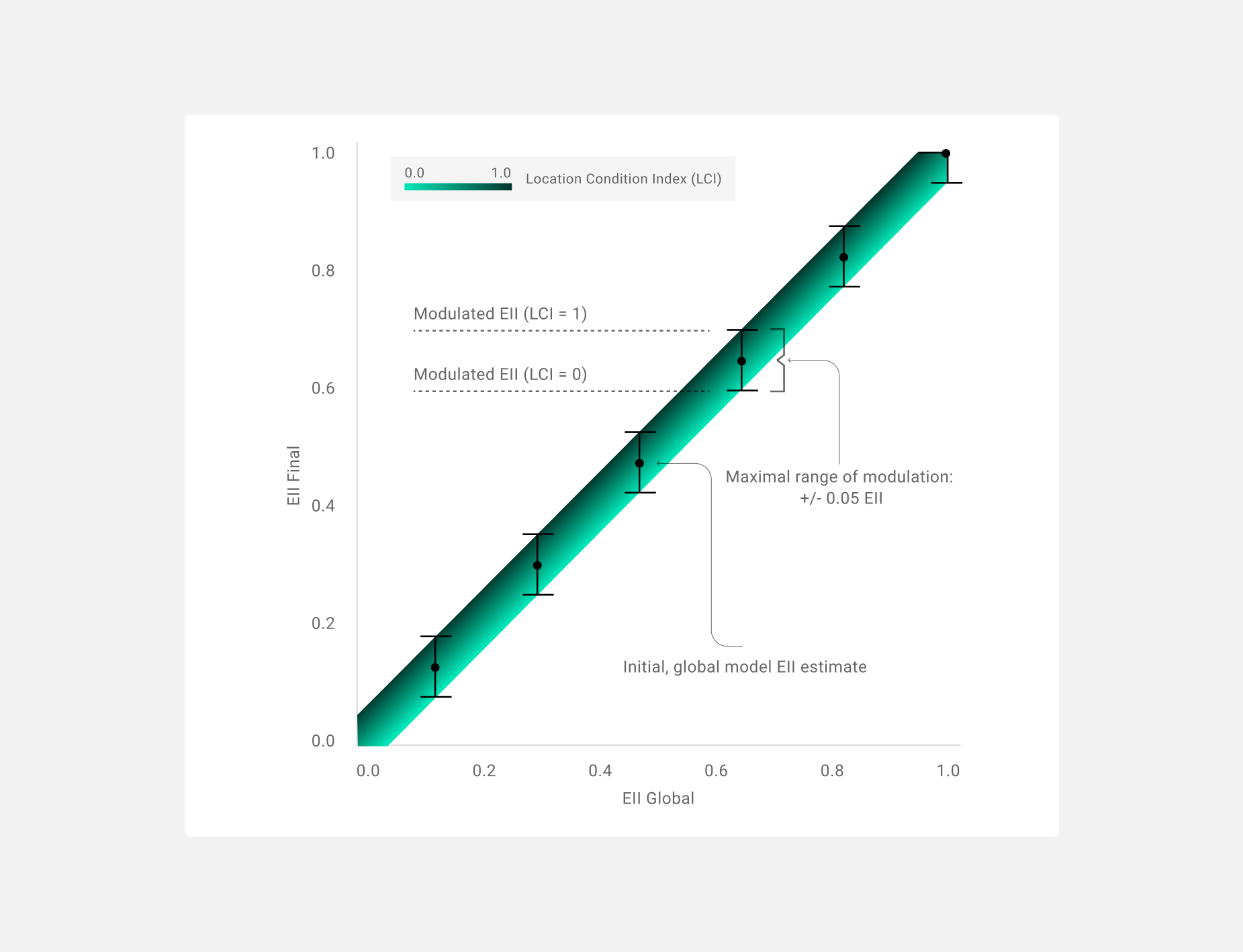
This feature allows the global, landscape-driven EII score to be adjusted using high-resolution, plot-level data. This creates a bridge between the macro and the micro:
- Global Foundation: The baseline EII provides a comparable standard across the globe.
- Local Refinement: Users can input specific Key Performance Indicators (KPIs)—such as soil organic carbon, water holding capacity, or habitat area—to modulate the score up or down based on verified local conditions.
The open-source release includes the modulation framework; users define and supply the KPI measurements appropriate to their context. A project in the Amazon might track different indicators than a project in the Scottish Highlands, yet both feed into a unified integrity framework. This design preserves global comparability while rewarding local action—without requiring a universal field protocol that would be impossible to implement at scale.
A Tool for the Nature Economy
This release is designed to be a practical tool for the financial and corporate sectors. By providing a transparent, scientifically grounded metric, the EII enables:
- Portfolio Assessment: Screening thousands of assets for nature-related risk.
- Target Setting: Defining clear, quantitative goals for nature recovery (e.g., “Improve EII from 0.4 to 0.6”).
- Nature Premiums: Tying financial incentives directly to verified improvements in ecosystem integrity.
- Investment Security: Underwriting nature-based solutions with a metric that proves they are delivering real ecological uplift.
Roadmap: Continuous Improvement
This release marks the first public version of the EII. The framework is designed for continuous updates as global datasets improve. Our roadmap includes:
- Annual Compositional Updates: Rebuilding the Biodiversity Intactness Index annually to ensure temporal consistency across all pillars.
- Structural Layer Refresh: Regular updates to the Human Modification Index underpinning structural integrity.
- Enhanced Temporal Alignment: Moving toward synchronized annual snapshots across all three pillars for true time-series analysis.
We are committed to transparent, ongoing development. As global Earth observation and biodiversity monitoring capabilities advance, the EII will evolve with them.
Join Us
We believe that for nature to count in the economy, we must be able to count nature—not down to the last critter, but well enough to act with confidence. By open-sourcing the EII, we invite the global community to use, refine, and build upon this foundation. Together, we can move closer to a world where every investment decision accounts for our planet’s ecological health.
Benjamin Leutner
Resources:
- Codebase: GitHub Repository
- Documentation: Technical Docs
- Whitepaper: The Ecosystem Integrity Index